


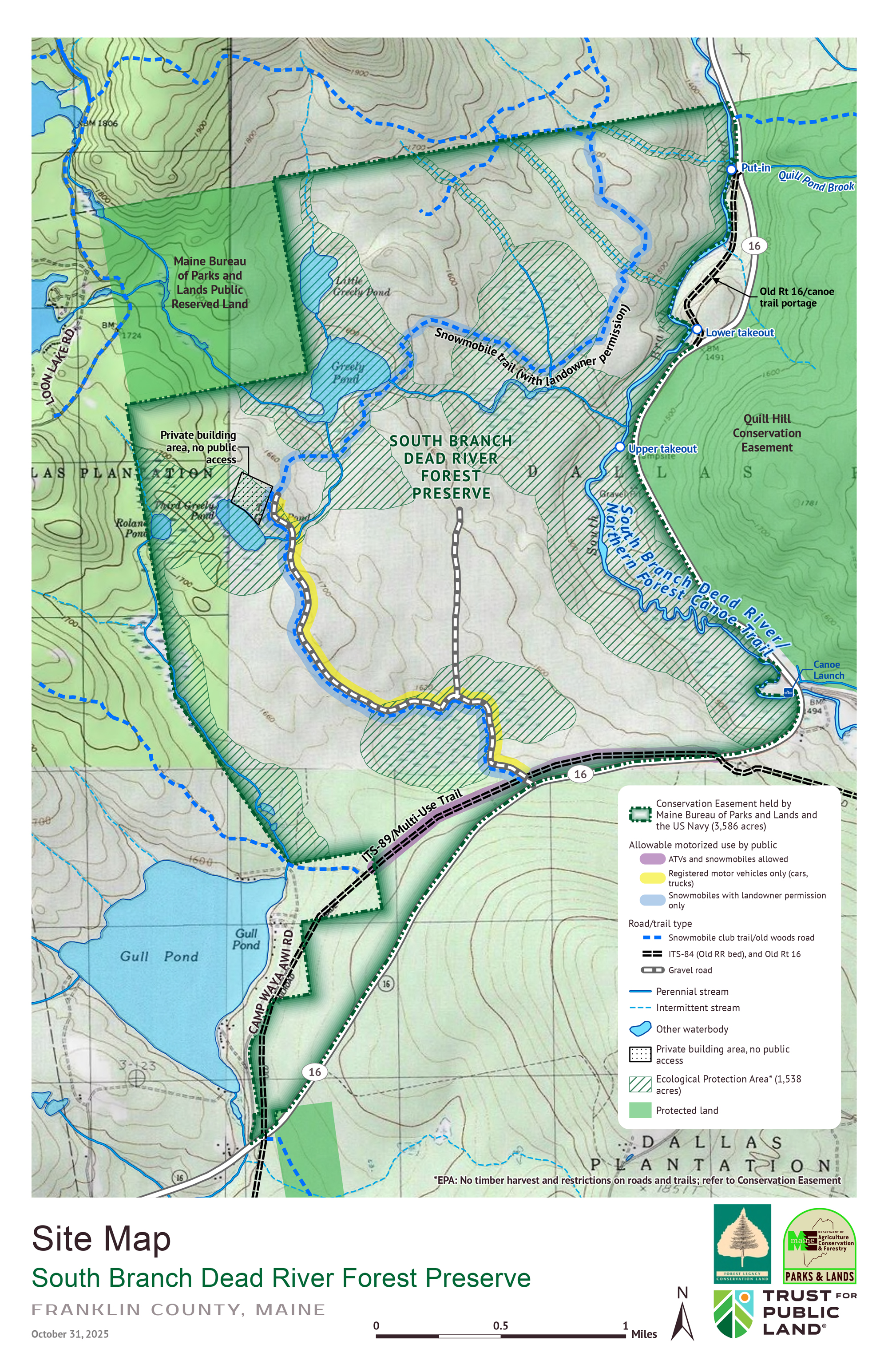
A five and a half square mile parcel of privately owned, ecologically diverse land in Western Maine's High Peaks region on the South Branch of the Dead River, at the headwaters of the Kennebec River watershed, has been permanently protected.
National nonprofit Trust for Public Land says the conservation easement on the South Branch Forest was secured in partnership with the Maine Department of Agriculture, Conservation and Forestry, the U.S. Navy, the U.S. Forest Service, and a number of foundations and individuals, including the landowner.
“In the past twenty years, Trust for Public Land has protected 213,000 acres of forestland in Maine, one-third of which is in Western Maine and the High Peaks region," Trust for Public Land's Maine state director Betsy Cook said in a press release. "Protection of the South Branch Forest and this section of the Northern Forest Canoe Trail will connect even more people to the outdoors, locally and across the state and northeast. We know that communities depend on those connections to the outdoors for health, economic wellbeing, social connections, and flood resilience. Projects like this are a 'need to have' for communities, not just a 'nice to have.'"
Gene LeFevre, a real estate developer from Philadelphia, owns the 3,586-acre property. He says he canoed the Dead as a young camper at Camp Kieve more than 60 years ago, and is a self-described "tree hugger" at heart. He purchased this parcel northeast of Rangeley during the pandemic.
"I was sitting there during Covid with nothing to do, and looked at the map and said, 'Well wouldn't that be fun to own some forest and then make sure that thrived?,'" said LeFevre. "So I went out and bought a couple of pieces, and that's what we're doing — really kind of enhancing them and leaving them alone."
According to Trust for Public Land, the newly conserved South Branch Forest preserve contains 580 acres of wetlands, 80 acres of lakes, three "Great Ponds," a seven-mile stretch of the South Branch of the Dead River, and healthy populations of moose, deer, waterfowl and brook trout.
The organization says the land will be managed for public outdoor recreation opportunities like hiking, hunting, birding and fishing. Sustainable timber harvest will continue to be allowed on about half of the area, and the other half will be dedicated to preserving older forests and sensitive habitats in support of the state's climate action plan and goals.
