

It happens all the time, Michelle Ames says. She'll be at the grocery store or some other public space, and because she's Deaf, people will try to speak to her children, who can hear, instead of her.
"And I say, 'Uh-uh, no. You talk with me.'" Ames says in American Sign Language. "They rely on my children because they can speak. They look for the easiest access, and they're afraid of what they don't know. They're afraid that they can't communicate with me."
She says that communication gap was highlighted after the mass shooting in Lewiston in which four Deaf men playing corn hole at a bar were among those killed. American Sign Language interpreters were initially restricted from entering hospitals, and the Deaf community struggled to get timely information in the aftermath.
Ames, who studied art in college and now does it in her spare time, created a mixed media piece that reflects her experience. It's currently on display at the University of New England Art Gallery in Portland in an exhibit titled "Unspoken Resilience," which Ames co-curated.
"There are many, many, many, many, many layers," Ames says as she looks at her piece, called "Unwrapping." "It's like my emotions, lots of layers."
The layers are made up of newspaper clippings from the day of the shooting, gauze, a piece of blue blanket and other materials that pop out from a piece of paper painted in bold colors. Ames says she started the piece by crumpling and folding these items together. It was like her emotions after the shooting, she says, wrapped tightly around her heart. For the final piece, she sliced the layers open to reveal a small mirror in the center.
"I was sort of like, wow, I've just opened myself up to show my experiences and all those feelings I had bottled up inside, showing that I'm not alone in this," she says. "There are other people. I wanted other people to see that they can also feel this way, and they can share their emotions."
Ames' piece is an example of De'VIA, or Deaf-View Image Art, which specifically expresses the Deaf experience. It's existed for a long time but was first named by a small gathering of Deaf artists in 1989. The genre is also open to artists who aren't Deaf but have ties to the community.

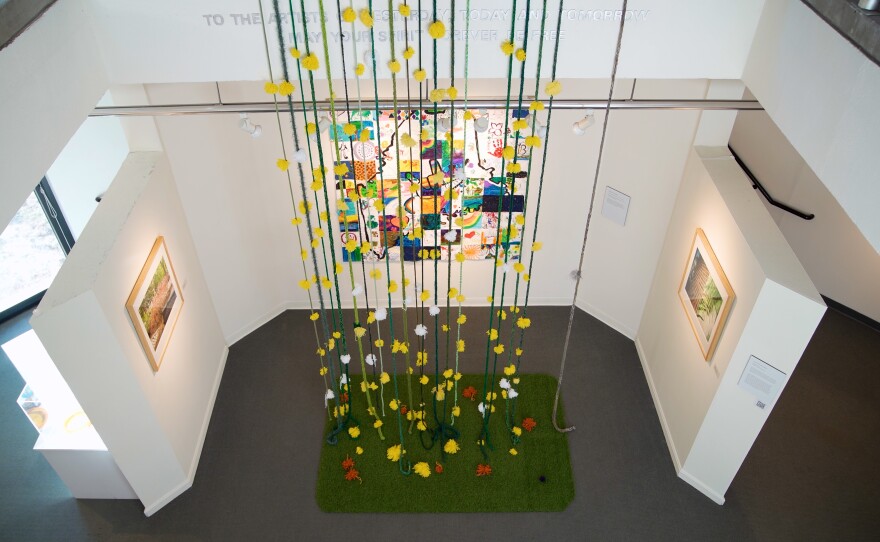
Meryl Troop, a professional nationally certified sign language interpreter, contributed a fiber piece called "Cascade of Dandelions."
"Using dandelions as a metaphor for the Deaf community and how you might mow the lawn, but the dandelions still come back," Troop says.
Troop is co-curator of the show with Michelle Ames. Troop says one of her favorite pieces is by Toby Silver, a Deaf artist from Washington, DC. It's a small quilt that depicts the state of Maine in pieces, stitched together by golden thread.
"What touches me is the gold lines that she used to indicate holding the state of Maine back together," Troop says. "This comes from the Japanese tradition of Kintsugi, and it holds that things are stronger in the broken places and become more beautiful."
The gold stitches are in sharp contrast to the forest-green fabric used for the state. Gallery director Hilary Irons says bold use of color is a common feature of De'VIA.


"So this is why you'll see a lot of things that are very kind of compositionally centralized, strong contrasts, like colors that are very expressive and direct," Irons says.
There are also common symbols, from flowers to facial features. Irons finds a series of paintings with a single eye peering out from the center, surrounded by loose brushstrokes, especially striking.
"It's been really exciting for me to learn about De'VIA artwork and its history," she says. "And you know, I wish that I had learned about it 20 years ago, with all of the other art history that I was taught."
Michelle Ames hopes visitors will come away from the show with a better understanding of the Deaf experience — and how important it is to communicate with Deaf people in the community.
"Hopefully this will help people recognize that they don't have to feel stuck," Ames says. "'Oh, I can't communicate. That means I can't talk with them. Oh, I have to learn American Sign Language first to be able to talk with them.' Absolutely not. Use your expressions. Be open. Just wave hello. Use a thumbs up. Gesture!"
Unspoken Resilience will be at the UNE Art Gallery in Portland through Feb. 8.
