


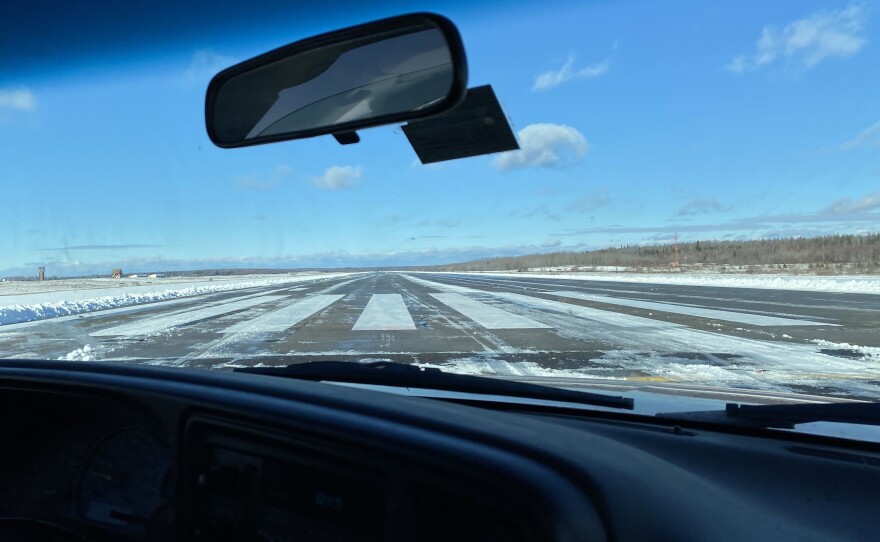
On a bright November day, Jonathan Judkins, president of the Loring Development Authority, barreled down a more than 12,000-foot runway in a pickup truck, to a corner of the base that he said once held nuclear weapons and secure intelligence facilities.
"That's a three story underground facility over there too. It's pretty cool," he said. "It's a little creepy in the basement...it's very creepy in the basement."
Judkins then swung the truck around and headed back toward the shuttered air traffic control tower, past an airplane hangar the size of three and a half football fields. A lot of work went into building this place, he said, "to sacrifice what we have and to throw it away would be a tragedy."


But one of Loring's drawbacks as a business hub is the very thing that made it a strategic asset for the U.S. military during the Cold War — its location. The base is far from population centers, but at one of the closest points to Europe in the continental U.S., as explained in a 1950s Air Force video.
"Aroostook County is in the northernmost part of the state," said the folksy voice of the film's narrator, Tech Sergeant Don Butler, of the Strategic Air Command, over a soundtrack of jaunty music.
During the Cold War, Loring was home to an arsenal of nuclear weapons, a fleet of enormous bomber planes, and, at one point, over 10,000 military and civilian personnel making the whole thing run.
"The experience of just being out in this great north country is something that you never forget," Butler continues, in the video. "But the thing that impressed us the most were the people."
And those who served at Loring said it had every amenity: A grocery story, a bowling alley, and a "base library, base gymnasium, craft shops, hobby shop. I mean, it was a town," said retired Air Force Captain Ray Hildebrand, who was stationed here for eight years in the 1970s and 80s.
It was "like living in a beehive," Hildebrand said, with jets roaring in and out at all hours. "I mean, the activity — there was never a dull moment."

But when the base closed in 1994, the beehive was abandoned and the population of Limestone cratered, from about 10,000 to less than 3,000 over a decade. And in the 30 years since, it's been a challenge to lure new businesses, other than two federal employers — the Job Corps Center and a defense accounting agency — and a handful of smaller firms. Many of the buildings on the sprawling base now sit empty.
But recently there have been signs of change. At one edge of the base recently construction crews were installing electrical systems, HVAC units, and other components inside the future Taste of Maine potato chip factory, which developer Jim Pelkey said is a $60 million investment that will eventually employ up to 75 people.
"I think that it's a substantial start," said Pelkey, who grew up in Limestone and said he's witnessed a lot of failed attempts to redevelop the base. "Hopefully, in my lifetime, I'll be able to see that this gets several other people to come forth and invest money in Aroostook County."

And some already are. As of last summer, there's been new activity inside an historic 86,000 square foot hangar that once housed B-36 bombers.
"So this is a [Boeing] 777 jet that's being retrofitted," said Jonathan Judkins, standing in the shadow of an enormous passenger plane draped in a veil of painter's plastic sheeting. It's the first of many planes that aircraft maintenance firm Aero Intelligence plans to work on here.
Judkins said Aero is one of Loring's newest tenants, drawn by the base's unique infrastructure.
"There are only a few places in this world you can go and get a hangar like that," he said.

Since Judkins took the helm of the Authority in 2024, he's focused on attracting businesses in the timber, agriculture, and aerospace industries. There's talk of establishing an aviation mechanics program and a biofuels production plant.
But he said there are still hurdles, such as securing federal funding for the transition of military bases to civilian use, and addressing PFAS contamination under the runway.
And not all the changes have been welcomed by the few dozen people who still live at Loring. Among them is Elaine Akerson.
"Once we got hit with that new water and sewer bill, it was like, 'What am I going to do?'" she recalled recently.
Akerson, who relies on Social Security, said her water and sewer payments have increased some 300% since last year. She's among a group of ten residents and business owners challenging the new rates before the Maine Public Utilities Commission.
"At the end of the month, if I have $200 in the bank, I'm lucky, and sometimes I have to skimp on my groceries in order to keep that amount," Akerson said.

Judkins said for years the authority heavily subsidized the water rates, but can no longer afford to do so. Regulators could soon issue a final decision in the case.
Limestone town manager Ed Pocock III said despite the challenges, a revived Loring is long-overdue.
"I mean, this town's been getting kicked in the teeth, really, for 30 plus years," he said.
Soon, though, he said the town will start bringing in much-needed revenue from the potato chip plant and Aero Intelligence.
"That's a huge amount of tax money this town has never seen before," he said.

And Pocock said other businesses considering a move to this part of the County shouldn't let the rural location scare them off, just as the Air Force urged Loring recruits some 70 years ago.
"We found a special type of friendliness in these people in northern Maine," said narrator Don Butler toward the end of the promotional Air Force video. "As we look back on it now, we wonder why we ever had any fears about coming here."
The hope this time around is that employers who decide to come here will stay for good.

